How to Name Your Tours for More Bookings (A Tour Operator's Guide)
Last updated May 2026
At a glance
- The right tour name does three jobs at once: it tells customers what they're getting, helps them find you in search, and gives them a reason to choose your trip over the one next to it.
- A working naming formula across high-performing operator websites: locale + activity + duration + differentiator + (optional) brand hook.
- Brandon Lake, co-owner of Moab Adventure Center, renamed four of his tours after combining SEO findings with customer research. Bookings climbed across all of them.
- The most common naming mistakes that cost bookings: vague names, missing locale, OTA-unfriendly punctuation, and names that contradict your positioning.
- Renaming an existing tour is worth doing if your current name is too generic or off-keyword. Coordinate the rename across your booking pages, OTAs, and Google Business Profile to protect what you've built.
Why your tour name matters more than you think
Your tour name is doing more work than any other piece of text on your site. It's the headline on the OTA listing. The Google ad result. The internal label your customer types into their group chat. The four words on the pickup sheet at 7am. If those four words don't communicate what the experience is, who it's for, and why someone should care, you lose the booking before they ever click "check availability."
Tour operators spend real money on marketing to put visitors in front of those four words. The math is brutal. The average tour operator website converts at 1-3%. A 1% lift on a 30,000-visitor-a-year site at $150 average order value is $45,000 in revenue you weren't getting before. Names are part of that lift.
A well-named tour does three things:
- Pulls in the right search traffic. "Moab rafting with BBQ lunch" is a real query. "River Trip 4" is not.
- Communicates value before the visitor reads anything else. The name carries the brochure summary.
- Differentiates you from the eight other operators offering the same thing. If your name reads the same as the next listing on Viator, you're letting price decide the booking.
See where your operation stands across the 25 indicators that move the needle on bookings, including how your product naming is set up. Takes about 10 minutes.
The naming formula that works
Across the operators we work with who are converting at the high end of the SERP, the names follow a consistent structure. Five elements, in roughly this order:
- Locale.
Where it happens. "Moab," "Grand Canyon," "Main Payette," "Upper Pigeon River." This is the single highest-leverage element for search visibility because most operator-related queries include a location. If you only get one thing right, get this.
- Activity.
What you do. "Rafting," "Hike," "Tour," "Expedition." Specific enough that a stranger can picture it.
- Duration. How long. "Full-Day," "Half-Day," "7-Day," "14 or 16-Day." Customers self-select on time before they self-select on price. Letting them see the duration in the name cuts down on bad-fit clicks that hurt your conversion rate.
- Differentiator. What's distinctive about your version. "with BBQ Lunch," "with Hike In + Helicopter Exit," "Whitewater," "Best of State." This is the line that pulls the booking away from the next operator in the list.
- Brand hook (optional).
A proprietary identifier some operators add for memorability. Cascade Raft and Kayak's "SPLASH" prefix is a good example. Use only when the brand asset earns the real estate.
Most strong names use 3-4 of these elements. A few use all 5. None use just one.
How operators actually build a name
The best tour name doesn't come from a brainstorm session. It comes from two pieces of research working together.
SEO research tells you what your customers are actually typing. Pull keyword data for your locale and your activity. Google Keyword Planner, Ahrefs, or Search Console will surface the queries with real monthly volume. You're looking for the phrases customers already use to describe the experience, not the phrases you wish they used.
Customer research tells you what they actually care about. Pull from your reviews, your sales call notes, your support tickets. What words come up over and over when customers describe why they booked, what they loved, or why they almost didn't book? Those are the words that belong in the name.
Where these two overlap is where the right name lives.
Brandon Lake, co-owner of Moab Adventure Center and CEO of Resmark Systems and ResmarkWeb, described the process directly on a recent operator webinar:
"We actually combined our SEO findings with our ideal customer profiling and we changed our product names. This might seem like a small thing, but I think it's one of the drivers that has really helped with this."
The "this" he's referring to is a 37% conversion rate increase and a $119,000 jump in one month's revenue at Moab Adventure Center, alongside a series of website and checkout changes. The renaming work wasn't the only driver. He called it out specifically as one of them.
Real tour names that are working in 2026
The clearest way to see how the formula plays out is to look at operators applying it. Here are five tour names from real Resmark customers, with the strategic move in each one.
Moab Adventure Center — four renames, four wins
Moab Adventure Center renamed four of its tours after running the SEO-plus-customer-research process Brandon described. Each rename took a generic, internally-named product and rebuilt it around what searchers were actually typing and what customers actually cared about.
| Before | After | The move |
|---|---|---|
| Horseback Midday Trail Ride | Castle Valley Horseback Ride | Added the specific locale. Castle Valley is a Moab landmark with its own search volume. |
| Colorado River Rafting Trip | Moab Rafting Adventure with Barbecue Lunch | Added geo (Moab) plus the searchable, craveable differentiator (BBQ Lunch). Brandon: "Put it right in the name." |
| Hummer Slickrock Safari | Hell's Revenge Slickrock Hummer Tour | Added the iconic landmark. Hell's Revenge is a famous off-road destination that has its own search volume. |
| Jet Boat Dinner and Night Show | Canyonlands by Night Dinner and Night Show | Adopted the established regional brand identity for nighttime experiences in Moab. |
The pattern across all four: make the specific, the searchable, and the iconic the first thing in the name. Generic internal labels became real product names that pulled their weight in search and on the page.
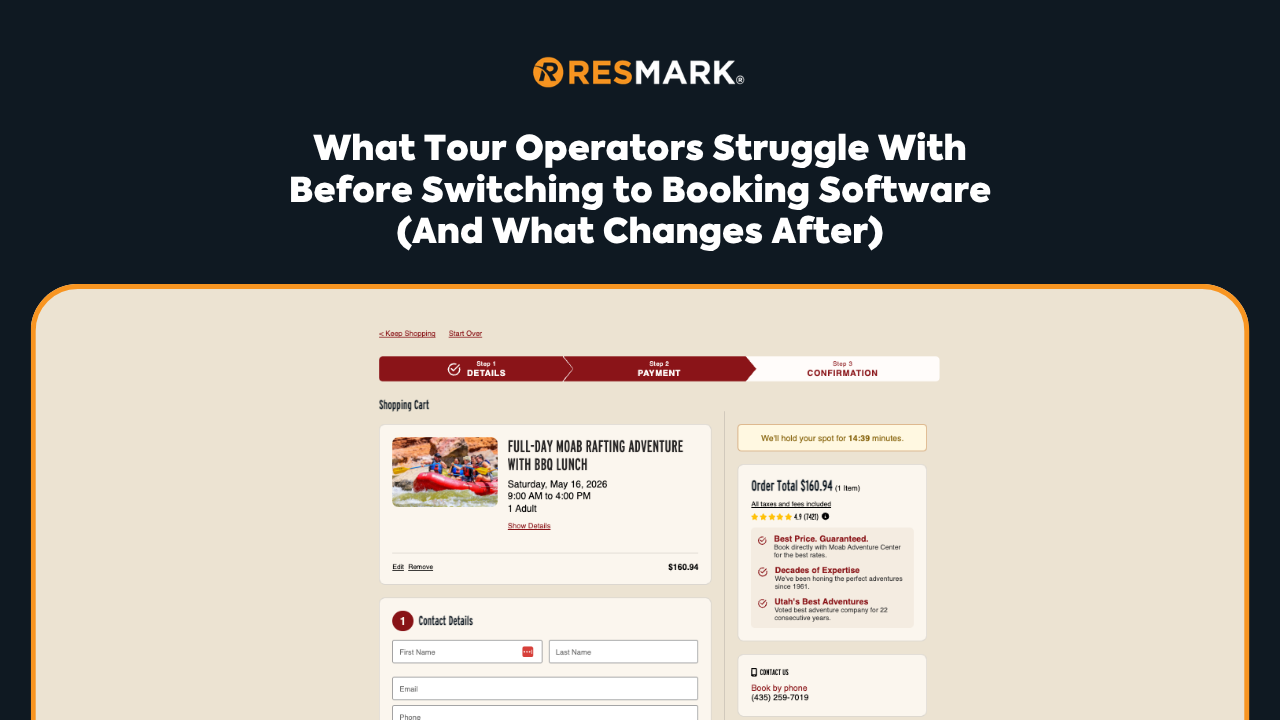
The Full-Day Moab Rafting Adventure with BBQ Lunch is now Moab Adventure Center's most-booked tour, with 7,573 reviews at 4.9 stars across Viator, GetYourGuide, and TripAdvisor.
Grand Canyon Expeditions — let customers self-select duration
14 or 16-Day Rowing Expedition - Grand Canyon Expedition
Putting "14 or 16-Day" first lets customers screen themselves on commitment level before they screen on price. "Rowing" rather than "rafting" is a deliberate signal to enthusiasts who know oar boats from paddle boats. The audience here is rafting-literate and willing to pay for the longer expedition. The name speaks their language.
CRATE (Colorado River and Trail Expeditions) — pack every word with value
Grand Canyon 7-Day Lower Rowing & Paddle Trip with Hike In + Helicopter Exit
This is a long name. Every word earns its place. Geo, duration, river section ("Lower" — Grand Canyon enthusiasts know what stretch that means), activity blend (rowing AND paddle, signaling variety), and two premium differentiators that justify the price. A first-time visitor to the page already understands what they're getting before reading a single line of body copy.
Big Creek Expeditions — specific river, specific water
Upper Pigeon River Rafting: Whitewater Trip
Specific to the river they operate on, not a generic "Tennessee rafting." Adding "Whitewater" distinguishes this from a scenic float, which is a real concern for customers comparing options. Short, descriptive, keyword-rich.
Cascade Raft and Kayak — when a brand hook earns its place
"SPLASH" is a proprietary brand asset that has been promoted in Cascade's marketing long enough to be memorable on its own. The rest of the name does the search work: Main Payette (geo), Half-Day (duration), River Rafting Trip (activity). A brand hook is worth real estate only when the brand investment is real.
How one paddleboard operator went from paper reservations to a fully digital operation with Resmark, and quadrupled their reservations in the process.
SEO research for your tour names in 30 minutes
Before you rename anything, spend half an hour in keyword data.
- Build a list of every locale, landmark, and activity word customers might use to describe your tour. Include the river, the park, the neighborhood, the famous viewpoint, the regional nickname.
- Run those words through Google Keyword Planner (free with a Google Ads account) or whatever keyword tool you have. Look at monthly search volume and competition for each.
- Note the head terms with real volume (100+ monthly searches in your market) and the long-tail variations that look like buying intent. "Moab rafting with lunch" beats "things to do in Moab" for a tour-naming purpose.
- Cross-check with your customer reviews. Search your review corpus for words customers use to describe the experience. If a review uses a phrase ("the BBQ was the best part") and the keyword tool shows search volume for that phrase, you have an alignment.
- Draft 2-3 candidate names per tour.
Run them past two or three customers if you can. Then choose the one that wins on both search volume and customer language.
Common naming mistakes that cost bookings
A few patterns to avoid, drawn from page audits we've done with operator clients.
Vague names.
"Fun Adventure Tour." Tells the customer nothing. Tells Google nothing. If the name could describe ten different experiences, it's too vague.
Missing locale.
"Half-Day River Trip" misses every search that includes the place. If you operate in Moab, the word Moab belongs in the name.
OTA-unfriendly punctuation.
Long dashes, special characters, and quotation marks can break OTA syndication or get rejected by Google Business Profile. Stick to letters, numbers, ampersands, and the colon.
Names that contradict positioning.
"Budget Moab Rafting" if you're positioning as premium. "Luxury Adventure Tour" if your average ticket is $99. The name has to match the rest of the marketing.
Hard-to-spell words.
Complicated brand-only words reduce searchability. People won't type what they can't spell.
Names that block Google Business Profile listings.
Some operators have run into GBP listing rejections for tour names that read as "keyword-stuffed." Keep the GBP product name clean even if the website name is more descriptive.
Should you rename an existing tour?
Renaming a tour that already has rankings, OTA listings, reviews, and customer recognition is a real cost.
Worth doing when:
- The current name is generic and you're losing search to better-named competitors.
- The current name doesn't match how customers describe the experience.
- You added a meaningful new differentiator (a feature, a location, an inclusion) that the name should reflect.
- Your search data shows real volume for terms you're not capturing.
Probably not worth doing when:
- The current name is performing and ranking. Don't fix what isn't broken.
- The change is purely cosmetic.
- You don't have the bandwidth to coordinate the rename across all channels. A half-finished rename creates more friction than the old name did.
If you decide to rename, here's the coordination checklist:
- Update the product name in your reservation system.
- Update the tour page URL (or 301 redirect the old slug to the new one to preserve SEO equity).
- Update OTA listings on Viator, GetYourGuide, Expedia, TripAdvisor, and any reseller partners.
- Update the Google Business Profile product name.
- Update email automations and customer service scripts that mention the old name.
- Notify reseller partners directly so they update their materials.
The whole sequence takes a few weeks. Run it in a clear cadence and don't drag it out.
Frequently asked questions
What makes a good tour name?
A good tour name communicates the experience clearly, includes searchable terms like locale and activity, and signals something distinctive about your version. The working formula across high-converting operator websites is: locale + activity + duration + differentiator, optionally prefixed with a proprietary brand hook. Most strong names use 3-4 of those elements; very few use just one.
How long should a tour name be?
Long enough to communicate what the experience is and what's distinctive about it. Short enough to fit cleanly on an OTA listing and a Google ad result. Practical range: 4-9 words. CRATE's "Grand Canyon 7-Day Lower Rowing & Paddle Trip with Hike In + Helicopter Exit" is at the long end and earns every word; "SPLASH" alone would be too short to do real search work.
Should I include my location in the tour name?
Yes, almost always. Locale is the highest-leverage element for search visibility because most tour-related queries include a location. "Moab Rafting" outperforms "Rafting Trip" by a meaningful margin in both visibility and click-through. The only exception is when your brand name already strongly signals locale (a regional brand identity built over years), and even then, including the geo in product names still helps.
Will renaming my tour hurt my SEO?
Not if you do it carefully. If you change the URL, set up a 301 redirect from the old URL to the new one to preserve ranking equity. If you keep the URL and only change the name on the page, the SEO impact is usually positive (because the new name better matches search intent). The bigger risk is inconsistency across channels: a half-finished rename where the website says one thing and the OTA listing says another creates friction and erodes trust.
Can I name my tour something cute and creative instead of descriptive?
You can, but pair it with a descriptive subtitle or use it as a prefix to a descriptive name. Cascade Raft and Kayak's "SPLASH: Main Payette Half-Day River Rafting Trip" is a good example. "SPLASH" is the brand hook; the rest does the search work. A purely creative name without descriptive context will struggle to rank and will confuse first-time visitors.
How do tour names affect OTA listings on Viator, GetYourGuide, and TripAdvisor?
Major OTAs index your tour name in their internal search and surface it on the listing card. A clear, locale-anchored, differentiator-rich name wins more impressions and clicks on the OTA, the same way it wins on Google. Keep punctuation simple. Long dashes, em-dashes, and special characters can break OTA syndication or get rejected by automated filters.
Does my tour name need to match my Google Business Profile?
The branded product name on your GBP should be clean and descriptive, but it doesn't have to be a word-for-word match of the name on your website. Some operators have run into GBP listing rejections for product names that read as "keyword-stuffed." Keep the GBP product name natural and let the website headline do the more aggressive search work.
What's next
Names are one piece of the conversion picture. They work hardest when they're paired with strong product pages, a clean booking flow, and ongoing testing. Two no-pressure paths from here.
See where your operation stands.
Get your free Growth Score. A 25-indicator scorecard self-assessment built specifically for tour operators. See where you're strong, where the leaks are, and what to fix first. Takes about 10 minutes.
Talk to us about your specific market.
Book a discovery call. We'll show you the Digital Revenue Opportunity Report we'd build for your operation. Your current organic revenue, the demand you're missing in your market, and the page-by-page opportunities ranked by projected lift. No deck, no pitch, just your numbers.
Share This Post